
Every January, it seems like Search Engine Optimization (SEO) experts come out of the woodwork to flood LinkedIn with predictions that never pan out. Some buzzwords stick, but many fade by February and are completely forgotten. With AI disruption shaking the very foundations of SEO, it’s harder than ever to separate signal from noise. Fortunately, there are ways to separate what’s real from all the hype, and we’re here to help with that.
In 2026, SEO isn’t just about keywords and backlinks anymore. Emerging dynamics like brand authority, AI-generated answer engines, and multichannel discovery are reshaping how content gets discovered, consumed, and ranked. The bottom line, though, is that SEO is still highly valuable and a vital part of what your company needs to keep growing and expanding as the world changes.
We’ll cut through the hype to bring you the five SEO trends already affecting search performance, backed by real data and shifts in Google and AI-driven search behavior. Plus, we’ll highlight two “trends” you can confidently ignore, so you can save your time and protect your budget as you move into and through the new year.
What you need to know about the real SEO trends for 2026, and what you don’t need to waste any time on.
5 SEO Trends Actually Impacting Rankings in 2026
SEO in 2026 isn’t future talk. These trends are happening now, and they’re rooted in shifts in search intent and behavior, Google’s evolving ranking systems, and the rise of AI in the discovery experience. With everything coming together to create a different experience, you need to be ready and willing to make the changes that will move your business to the front of the pack, without losing sight of technical SEO fundamentals that drive organic search and search visibility.
1. E-E-A-T and Brand Authority Matter More Than Ever
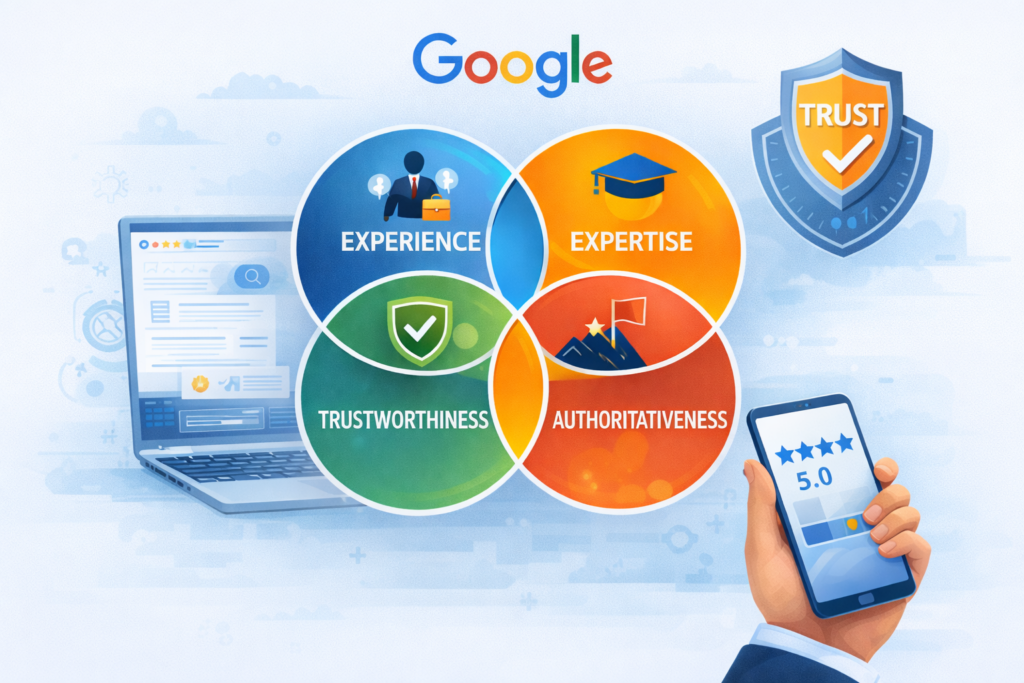
SEO pros have always talked about expertise, authoritativeness, and trustworthiness, but in 2026, the landscape has shifted toward experience, as well. That forms the E-E-A-T framework that Google and the search ecosystem increasingly favor.
Google’s official documentation stresses that its systems prioritize helpful, reliable, people-first content over material designed to manipulate rankings. While E-E-A-T isn’t a single quantifiable metric, strong E-E-A-T correlates with better visibility and stability in organic results and related AI-powered summaries that now appear in AI powered search and AI mode experiences.
In short, E-E-A-T adds value to the content you’re producing, instead of just keywords. If you’re still stuffing extra keywords into your blogs and web pages to try to rank highly, you could be missing out on a lot of Google searches. Instead of adding the “right” words to everything, focus on incorporating them organically while you create strong value for the reader.
Why it matters in 2026:
- Brand signals are increasingly visible in Google’s tools, including brand query filters and entity recognition in Search Console, which indicates that Google is placing more weight on who you are, not just what you write.
- Branded search volume acts as a trust proxy. If users search for a brand by name, Google treats it as a credibility signal that can compound search traffic.
- AI systems (including Google’s AI Overviews and generative engines) pull from a wide range of references, meaning brand mentions in external contexts contribute to perceived authority and AI visibility.
Actionable takeaway: Build your digital footprint beyond your website. Get mentioned in industry publications, earn reviews, engage with communities, and optimize for brand discovery and entity recognition.
2. First-Person, Experience-Based Content Wins
Generic, AI-generated content floods the web, and it’s becoming frustrating for a lot of readers and searchers to wade through. They’re looking for quality answers to their questions and concerns, but they’re not always finding it. If you can provide it for them, you have a real chance at a deep level of loyalty from your readers.
In contrast to the generic information that AI-generated content provides, content grounded in real firsthand experience cuts through the noise, and that’s especially true for complex or nuanced topics.
Google’s E-E-A-T framework explicitly values experience, meaning content that demonstrates real-world application performs better.
For example:
- “I tested 10 email marketing tools for 6 months” outperforms “Best email marketing tools of 2026” because it signals genuine experience and context from someone who’s actually done the research.
- Headers and titles that reflect personal involvement (“Here’s how we improved our organic traffic 47%”) often have stronger engagement than generic SEO titles, because readers want to know what you did that actually worked, and whether it will work for them, too.
Actionable takeaway: Don’t just inform with the content you provide. Show your work by including screenshots, data, personal insights, and why you recommend something rather than restating surface-level descriptions.
3. AI Overviews Are Eating Clicks — Structure Your Content to Get Cited
One of the single biggest dynamics changing SEO in 2025 and 2026 is the rise of AI Overviews. These are AI-generated summary blocks that answer user queries directly on the search results page. Love them or hate them, they aren’t going away, so you’ll need to work with them to keep your company’s rankings high and continue to get noticed.
Data shows zero-click searches surged after AI Overviews launched, with zero-click rates climbing from about 56% to around 69% in key periods following rollout. This has a profound impact on your company and its content.
Consider the facts:
- Top organic positions now often generate far fewer clicks because users get answers without scrolling.
- AI systems increasingly cite sources rather than send users to click them, which means getting cited in those answers is often more valuable than ranking #1 organically.
Actionable takeaway: Structure your content with clear, concise answer blocks, FAQ sections, and schema markup so AI systems can extract and incorporate your content into summaries. Include quoted statements and structured data that make your content easy for AI to reference.
4. “Search Everywhere Optimization” Is the New SEO
The days of “optimize only for Google” are over. People find information through a staggering array of search interfaces:
- TikTok for product discovery and how-to content
- YouTube for tutorials and explanations
- Reddit and Quora for authentic community insights
- AI tools like ChatGPT, Perplexity, and Gemini for synthesized answers
This fragmentation means traditional SEO alone misses where users actually search and decide. Community platforms like Reddit and Q&A forums often rank highly in AI answer citations, and social platforms are becoming search engines in their own right.
That doesn’t mean you want to optimize for socials too much, though. Standard SEO is still the most important way to get yourself and your content found. However, it’s important to make your way toward an expanded reach, and that can include social media as one spoke in the wheel.
Actionable takeaway: Think Search Everywhere Optimization. Create native content for each platform rather than simply repurposing your blog posts. Optimize TikTok and YouTube videos for discoverability, engage in Reddit communities with helpful answers, and format FAQ-style content for AI citations.
5. User-Generated Content and Community Signals Are Rising
Authentic user voices are a goldmine for search and AI discovery. Community platforms like Reddit and Quora have seen explosive traffic growth, with some reports estimating Reddit up 600% and Quora up nearly 380% over recent periods as users seek real answers.
This shift is driven by:
- Users preferring genuine experiences from peers versus polished corporate content.
- AI systems pulling answers from diverse voices, including forums, reviews, and social mentions, as part of their response synthesis.
In short, people want the connection to other people, and want to know what their peers think about ideas, products, and the world around them. Additionally, the change in how content ranks due to AI systems and their answers means social and forum information is making its way into search queries far more often.
Actionable takeaway: Encourage reviews, actively participate in relevant communities, and nurture user communities like forums, Discord, or Slack groups where authentic discussions unfold. This builds trust and exposes your brand to the signals AI and search systems increasingly reference.

2 SEO “Trends” That Are Just Hype
With so much change, it’s easy to chase shiny new tactics that distract from real impact. Unfortunately, that can stop you from really focusing on the trends that can help you, while you get mired in the Next Big Thing. Here are two trends getting too much buzz without the results.
Hype #1: You Need to Completely Pivot to Optimize for ChatGPT/Perplexity
There’s a narrative that SEO must now be reconfigured entirely for AI tools like ChatGPT or Perplexity. But the data suggests a narrower reality. Google still holds roughly 90%+ of global search market share, so that’s where your optimization focus should remain.
Additionally, most AI search tools pull information from the same underlying web sources Google indexes. In other words, you won’t get visibility in AI answers that you don’t already earn with authoritative, quality content.
Optimizing exclusively for chatbot discovery without building real authority on the open web is putting the cart before the horse, and can mean you’ll get a lot less of a boost than you’re hoping for. Don’t waste your time with this strategy.
Instead: Focus on SEO foundations that work across all kinds of platforms, like quality content, brand authority, structured data, and user engagement signals. These are the foundations of both traditional search rankings and visibility in AI summaries.
Hype #2: More Content = Better Rankings (AI-Generated Content at Scale)
Some vendors push the idea that churning out tons of AI-generated posts will drive unbeatable visibility, because it floods the web (and the search results) with content that’s tied to your company. While that sounds like a good idea on the surface, this strategy often fails.
Why? Because short, superficial posts may satisfy quantity goals, but Google’s quality systems (e.g., Helpful Content Update) explicitly aim to demote content created primarily to attract visits from search engines rather than help users. You could be metaphorically shooting yourself in the foot by producing too much content that really doesn’t say anything valuable.
Volume without depth dilutes your brand authority and creates redundancy that AI and search systems filter out, so all that extra effort to create more content isn’t going to do what you’re hoping it will. It could backfire, causing you to show up less, instead of more.
Instead: Invest in fewer, higher-quality pieces that offer unique value and satisfy user intent. Give readers what they actually want to find, not just more content branded to your company. Also, refresh and expand existing content rather than launching new, low-impact pages.
The Bottom Line: Focus on What Actually Works
2026’s SEO landscape rewards authenticity, authority, and user value, so that’s where you want your company’s content focus to be. While AI tools and new formats change how people discover information, the fundamentals of SEO, including helpful content, strong brand signals, and a user-centric experience, remain central to a strong content strategy.
Instead of chasing every new trend, double down on building trusted authority, structuring content for real human and AI consumption, and measuring meaningful engagement instead of vanity metrics.
Want help navigating the evolving world of SEO in 2026? Contact us at NextLeft today, and let’s talk about how we can help you create a no-nonsense SEO strategy grounded in what’s actually working.