

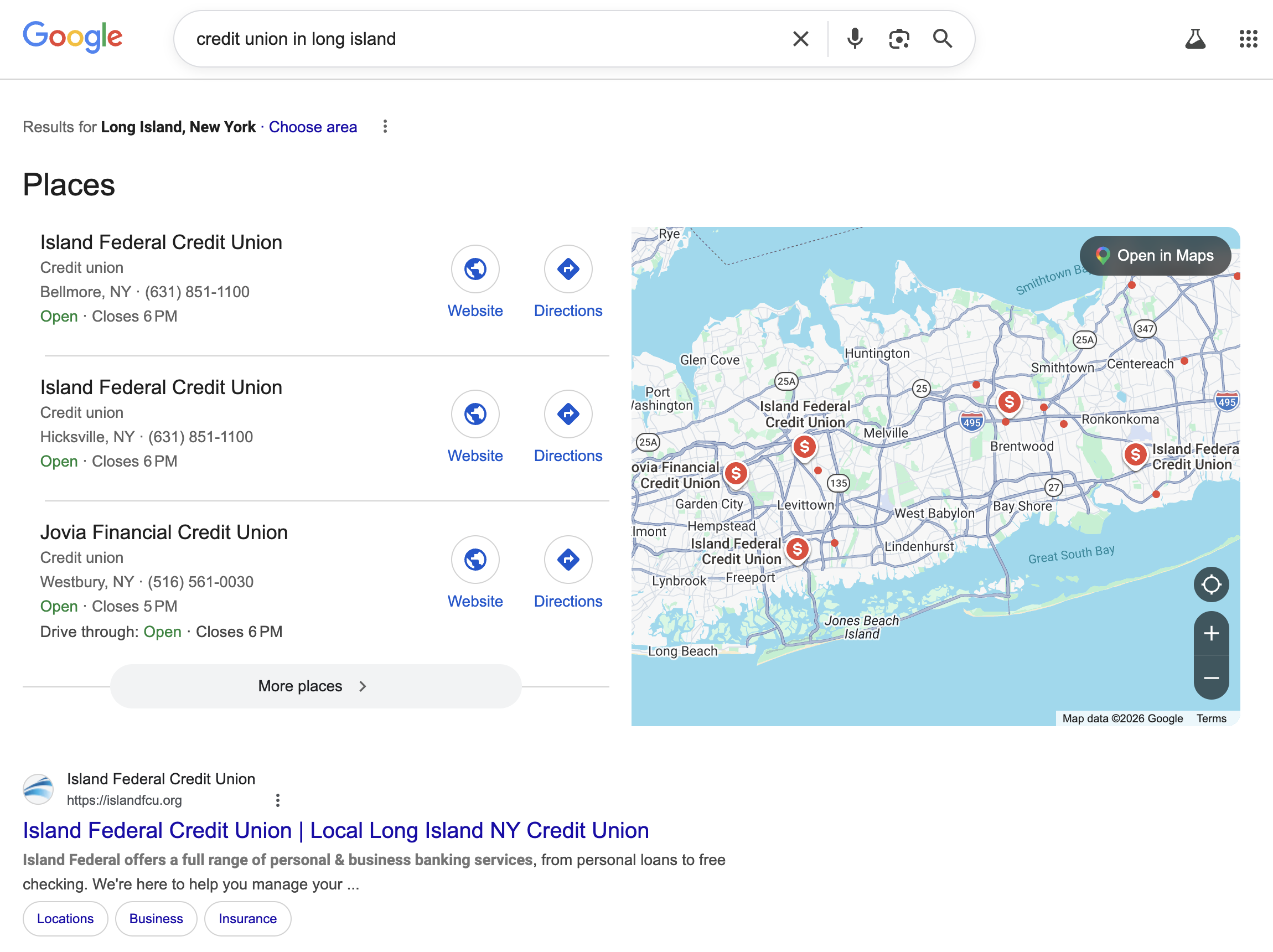
Credit union growth today depends on being visible exactly when potential members are searching, as well as showing up with the right information at the right time. Whether someone is looking for “credit union near me,” comparing “auto loan rates in [your city],” or researching how to open a checking account online, those searches signal real intent. If your credit union isn’t present, or if your competitors are more visible, more informative, or easier to act on, you’re missing opportunities to earn trust and win new relationships.
Consumers generally expect clear eligibility requirements, transparent product details, easy digital experiences, and strong local credibility before they ever step into a branch or start an application. That means Search Engine Optimization (SEO) isn’t just about rankings, but about aligning your website, branch presence, and content with how people actually evaluate financial institutions.
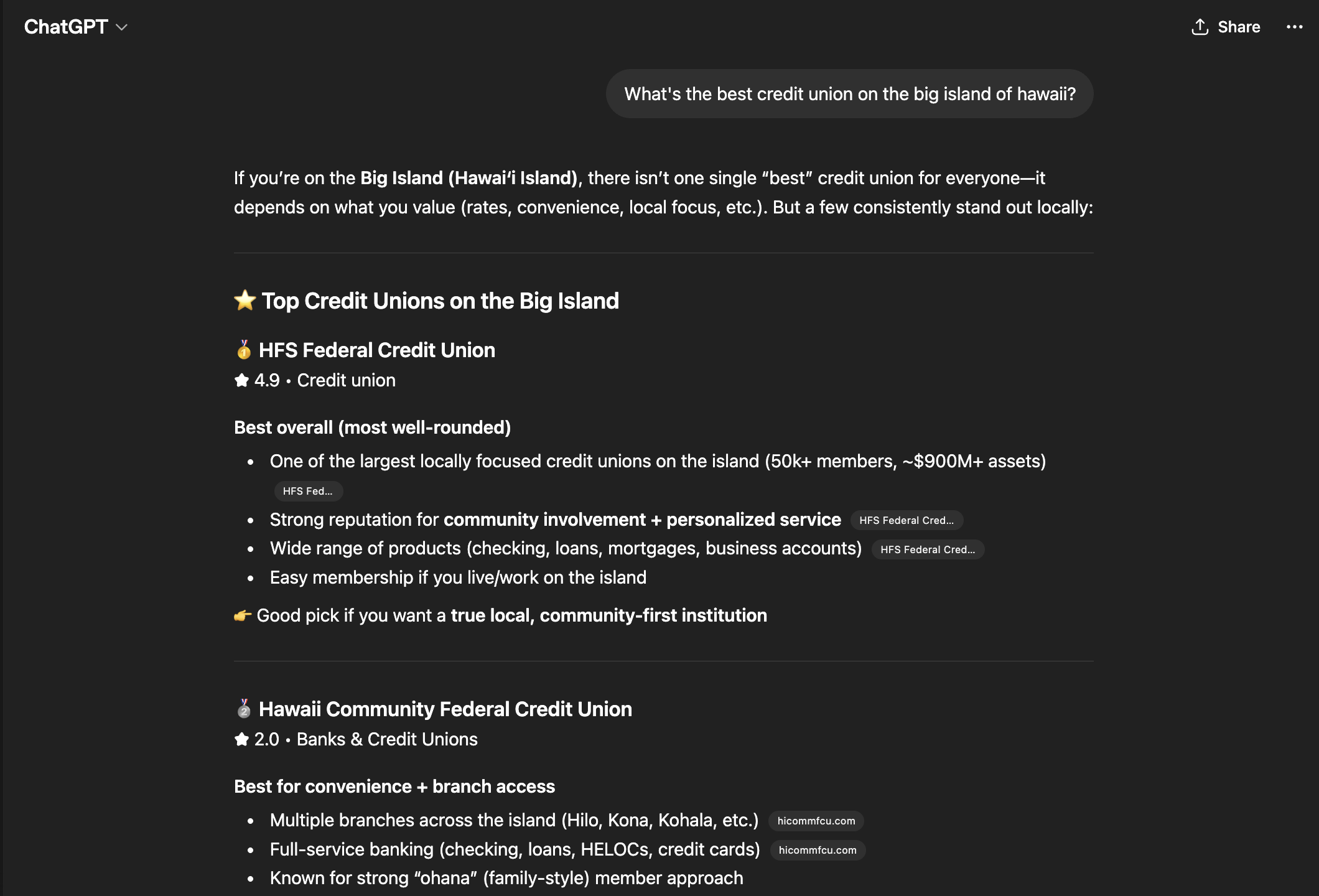
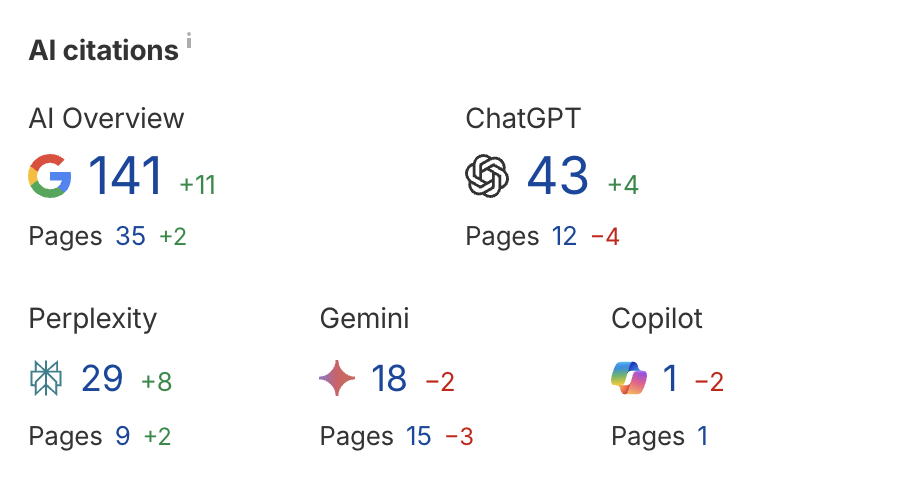
AI Search and Generative Engine Optimization (GEO) are becoming more important for credit unions as more people discover brands through AI-generated answers, not just traditional search results. That means your content needs to be clear, trustworthy, and easy for AI systems to understand. Strong product pages, helpful FAQs, clear eligibility details, and consistent local information can all improve your visibility across both search engines and AI-driven experiences.
Here’s what to consider about how to build a practical, compliance-aware, and high-performing credit union SEO strategy, including how to connect search demand to your most important pages, improve visibility across both local and product-driven queries, and create a seamless path from discovery to membership, application, or in-branch visit.
Understanding Credit Union SEO
Credit union SEO isn’t just about ranking blog posts or increasing website traffic. It’s also about showing up at the exact moment a potential member is ready to take action, so you can guide them to the right place. Unlike more general SEO strategies, success here depends on connecting high-intent searches directly to the pages that drive real outcomes, whether that’s opening an account, applying for a loan, or visiting a branch.
Defining Credit Union SEO Essentials
Credit union SEO is the process of optimizing your website, branch presence, and digital footprint so that your institution appears in search results for the queries that matter most, including local, product-specific, and membership-related searches. This includes everything from ensuring your branches show up for “credit union near me” searches to making sure your checking accounts, auto loans, and mortgage offerings are easily discoverable when users compare financial options in your area.
A strong credit union SEO strategy prioritizes local intent, making it easier for you to capture nearby searchers actively looking for financial services. It also emphasizes product visibility, ensuring that your core offerings, like savings accounts, loans, and credit cards, rank for relevant queries tied to both your location and customer need.
Beyond your website, your Google Business Profile also plays a critical role as a conversion channel, and often serves as the first touchpoint where users call, get directions, or visit your site. Underpinning all of this is trust, which requires clearly communicating membership eligibility, maintaining transparency around rates and fees, and presenting a credible, community-focused presence that strengthens your credit union’s visibility.
The conversion path: SEO → local or product search → product or branch page → application or appointment → new member or funded loan.
How Credit Union SEO Differs from General SEO
Your credit union operates in a more complex environment than most industries, where geography, compliance considerations, and trust all play an outsized role in search performance. General SEO strategies often aim for broad visibility, but credit union SEO needs to be far more targeted and intentional for search engine algorithms. Geographic relevance is critical, not just in terms of the city or region but also in relation to field-of-membership requirements, which can influence who’s eligible to join.
Local visibility is another major differentiator, as credit unions rely heavily on appearing in map pack results and local searches, making branch-level optimization just as important as website performance. At the same time, SEO efforts should be anchored in product and service pages, such as checking accounts, auto loans, and mortgages, rather than relying primarily on blog content to attract traffic.
Trust also carries greater weight in this space. Financial decisions involve higher stakes, so users look for clear signals of credibility, including accurate rates, transparent terms, strong reviews, and a consistent brand presence across all touchpoints. This introduces an added layer of complexity, as content needs to remain compliant and up to date, especially when you’re referencing rates, fees, or financial guidance.
Competition further raises the bar, and your credit union isn’t just competing with others. It’s also up against large banks with significant marketing budgets and fintech companies that excel in digital experiences. As a result, your SEO strategies should balance local authority, product clarity, and user experience to remain competitive.
| Factor | General SEO | Credit Union SEO |
|---|---|---|
| Geographic Focus | Often broad or national | Hyper-local + service areas |
| Primary Conversions | Leads, signups | Accounts, loans, appointments |
| Page Types | Blogs, landing pages | Product, branch, membership pages |
| Trust Signals | Reviews, authority | Reviews, rates, security, compliance |
| Content Priorities | Informational content | Product + local + educational mix |
| KPIs | Traffic, rankings | Applications, funded loans, visits |
Why SEO Matters for Credit Unions
SEO is one of the few marketing channels that captures intent at the exact moment someone is ready to act. Unlike display ads or social media, where you’re creating demand, search allows you to meet that demand, instead. When a potential member is actively looking for a financial institution, comparing loan options, or deciding where to open an account, their search behavior signals urgency and intent. A successful SEO strategy ensures your credit union is visible in those moments and positioned as a credible, convenient, and trustworthy choice.
Drives Qualified Membership and Product Demand
One of the biggest advantages of SEO for credit unions is the ability to attract highly qualified traffic, i.e. people who are already searching for exactly what you offer. Queries like “credit union near me,” “auto loan rates in [your city],” and “open checking account online” are not casual searches, but signals that someone is actively evaluating their options and looking to take the next step.
When your product pages and membership pages are optimized for these terms, search traffic flows directly into your most valuable conversion points. Instead of relying on users to navigate through multiple pages or hunt for information, SEO aligns their query with a page designed to meet their needs immediately, which creates a more efficient path from search to action and increases the likelihood of account openings, loan applications, and new member acquisition.
Proof Point: A large majority of consumers use search engines to find local services, and a significant portion of those searches happen on mobile devices, often leading to action within a short timeframe. According to the American Bankers Association, 55% of consumers use their mobile app for financial services management.
Boosts Local Visibility and Branch Discovery
For your credit union, local visibility is critical, not just for foot traffic, but for establishing trust and credibility within your local community. SEO plays a central role in ensuring your branches appear in Google’s map pack results, “near me” searches, and both branded and non-branded queries.
Even for credit unions with strong digital banking capabilities, branch visibility continues to influence decision-making, and many users still want to know that a physical location is nearby, accessible, and staffed by real people if they need assistance. Optimized branch pages and a well-managed Google Business Profile are essential ways to help bridge the gap between digital discovery and in-person engagement.
Builds Trust, Consideration, and Conversions
Financial decisions come with a higher level of scrutiny, which means trust is a key factor in converting searchers into members. SEO supports this by ensuring that the right signals are visible at the right time, and when users land on your site, they’re often looking for reassurance. If you offer them clear reviews and ratings, transparent information about fees and rates, evidence of community involvement, and strong security or fraud protection messaging, they feel more confident in what you have to offer.
CRO Tip: To capture momentum, add sticky calls-to-action like “Open an Account,” “Apply Now,” and “Book Appointment” across key product and branch pages. These persistent, easy-to-access options reduce friction and make it simple for users to take the next step as soon as they’re ready.
Know Your Credit Union Member Types First
Understanding your audience shapes every part of an effective SEO strategy, from the keywords you target to the way your pages are structured and the calls-to-action you prioritize. Not every searcher is at the same stage of their journey, and not every potential member is looking for the same thing. By identifying distinct member types, you can align your content, product pages, and user experience to meet their expectations.
“Switcher Sarah” (Ready to Leave Her Bank)
Switcher Sarah is actively looking for a better alternative to her current bank. Her searches tend to focus on finding nearby options and comparing benefits, using queries like “best credit union near me” or “free checking account in [city].” What she needs most is clarity and reassurance, along with streamlined application flows, clear next steps, and visible trust signals to help her move forward with confidence.
“Borrower Ben” (Needs Financing Soon)
Borrower Ben is driven by urgency, because he’s looking for a loan and already comparing rates and lenders. His searches are highly transactional, including phrases like “auto loan rates in [your city]” or “mortgage pre approval credit union.” To convert Borrower Ben, your SEO strategy needs to prioritize speed, clarity, and action, with strong, prominent calls-to-action like “Apply Now” or “Get Pre-Approved,” so he can find what he needs and take the next step.
“Planner Priya” (Researching Before Acting)
Planner Priya is in the early stages of her journey. She’s thoughtful and research-driven, taking time to understand her options before making a financial decision. Her searches are more informational, such as “how to choose a credit union” or “high yield savings vs money market,” so educational content plays a critical role for its clear explanations, side-by-side comparisons, and resources that help her feel informed and confident.
Simple Journey Maps
Each of these member types follows a slightly different path, but successful credit union SEO ensures that every one of their journeys are smooth, intuitive, and aligned with their intent.
The membership path typically begins with a search that leads to a membership or “join” page. From there, users look for eligibility requirements and a clear explanation of benefits before completing the account opening process. In contrast, the loan path is often more action-oriented, as a user searches for a specific loan product, lands on a product page, and may use a calculator to estimate payments or rates.
The branch path connects digital search to physical interaction, since a user searches for a nearby credit union, lands on a branch page, and looks for directions, hours, or contact information. This often leads to an in-person visit or scheduled appointment, so consider strong local SEO and optimized branch pages to ensure a seamless transition from online to offline.
Understand Search Intent to Align with Member Demand
A successful credit union SEO strategy starts with understanding why someone is searching, not just what they’re searching for. Search intent reveals where a potential member is in their decision-making journey, which directly informs the type of content you should create and the actions you should encourage them to take. Instead of forcing users to navigate your site to find what they need, intent-driven SEO meets them exactly where they are and guides them forward naturally.
The 4 Search Intent Types
Search intent generally falls into four categories, each requiring a different type of page and a different approach to conversion.
Informational: This reflects early-stage research, and these users are looking to understand concepts, compare options, or educate themselves before making a decision. Searches like “what is a credit union?” or “how do auto loans work?” signal curiosity rather than immediate action. To meet this need, your credit union should provide helpful guides, FAQs, and educational content that clearly explain key topics. The goal here isn’t to push an application right away, but to build trust and guide users toward the next step with soft calls-to-action like “learn more” or “compare options.”
Navigational: This intent happens when users are looking for a specific credit union or location. Searches such as “[credit union name] hours” or “[credit union name] routing number” show that the user already knows who they’re looking for, they just need quick access to information. In these cases, well-optimized branch pages and help center content are essential, and should make it easy to take immediate action through clear options to call, get directions, or access key details.
Transactional: This intent is where conversion opportunities are strongest, because these users are ready to act and looking for ways to complete a specific task, such as “open checking account online” or “auto loan pre approval in [your city].” For this intent, your product and application pages must be highly optimized, fast-loading, and easy to use with clear, prominent calls-to-action like “Apply Now” or “Open an Account.”
Commercial: This intent is where users are comparing options and evaluating which credit union or product best meets their needs. Searches like “best credit union for auto loans in [your city]” or “credit union vs bank for checking” show that the user is close to making a decision but wants reassurance first. You can use comparison pages, rate pages, and detailed product overviews, supported by calls-to-action such as “compare accounts” or “check eligibility” to help move these users toward conversion.
Content Cluster Framework
To effectively capture and guide users across all stages of intent, your SEO strategy should be organized into a clear content cluster framework of hubs. Rather than creating isolated pages, this approach builds a connected ecosystem where each piece of content supports the broader goal of moving users from discovery to conversion.
At the center of this structure is the membership hub, which serves as the foundation for anyone considering joining your credit union. This hub should clearly explain who’s eligible, outline the benefits of membership, and provide a straightforward path to join.
Surrounding this are your product hubs, which focus on the specific financial services you offer, such as checking accounts, savings products, auto loans, and mortgages. Each product area should have its own dedicated section with detailed pages that highlight features, explain benefits, and guide users toward applying.
Your location hub supports local SEO efforts by organizing branch and city-specific pages that help you rank for “near me” and location-based searches while providing essential information like hours, directions, and services offered. They also serve as a bridge between online discovery and in-person engagement, reinforcing trust and accessibility.
Finally, the education hub captures early-stage and research-driven traffic, including guides, calculators, and comparison content designed to answer questions and build confidence. While these pages may not convert immediately, they play a crucial role in nurturing potential members and leading them toward your product and membership pages over time.
Key insight: When structured correctly, each of these hubs connects directly to relevant conversion points with a simple hub → page → conversion path linking that ensures users can enter your site and find a clear and logical way forward.
Keyword Research Strategies for Credit Union SEO
High-Value Keyword Types
| Keyword Type | Example | Volume | Competition |
|---|---|---|---|
| Core | credit union [your city] | High | High |
| Product + Location | auto loan rates [your city] | High | High |
| Eligibility | who can join [CU] | Medium | Medium |
| Comparison | best credit union checking | Medium | High |
| Branch | credit union near me | High | High |
| Loan Intent | refinance auto loan | High | High |
| Branded | routing number | Medium | Low |
Tools and Process
Effective keyword research for credit union SEO starts with the right tools, but it’s the process behind how you use them that ultimately drives your results. The goal isn’t just to find high-volume keywords, but to uncover the terms that align with real member intent and map them to the pages that convert.
Tools like Google Keyword Planner help you identify search volume trends and discover variations of core terms, especially when you start layering in product and location modifiers. Additionally, Google Search Console provides valuable insight into the search queries your site already appears for, including opportunities where you’re close to ranking higher with small optimizations.
Google Business Profile (GBP) Insights adds another layer by showing how users find and interact with your branch listings, which is especially useful for local SEO strategy, and rank tracking tools round out your toolkit by helping you monitor performance over time, track improvements, and identify competitive gaps across key markets.
You’ll begin by defining your core terms, which should be broad phrases like “credit union,” “checking account,” or “auto loan.” From there, you’ll expand those terms by adding modifiers tied to products, locations, and member needs, such as “auto loan rates in [your city]” or “free checking account near me.” Once you’ve built out your keyword set, the next step is mapping each term to a specific page type. Not sure if you’re using the right terms? Request an audit from us at NextLeft and see where you stand with your current credit union SEO efforts.
Prioritization is where your strategy comes into play, so instead of focusing only on search volume, your credit union should weigh its target keywords based on their conversion value, competitiveness, and relevance to their field of membership. A lower-volume keyword tied to a high-value product, like a mortgage or auto loan, can be far more impactful than a high-volume informational term that rarely converts.
Long-Tail Opportunities
While broad, high-volume keywords are important, long-tail keywords often present the biggest opportunity for credit unions like yours, especially if you’re competing in a crowded local market. These longer, more specific search phrases typically have lower competition and reflect more defined intent, which makes them highly valuable from a conversion standpoint. For example, consider using phrases like:
- “best credit union for teachers in [your state]”
- “credit union auto loan refinance [your city]”
- “first time homebuyer program credit union [your city]”
- “checking account with no monthly fee [your city]”
- “shared branching credit union near me”
- “how to join a credit union without employer membership”
- “best savings account for kids [your city]”
- “credit union business checking near me”
By creating targeted pages or content that directly answers these queries, your credit union can capture highly qualified traffic that’s more likely to convert. Additionally, long-tail keywords often provide a strategic entry point for smaller or mid-sized credit unions that may struggle to compete for broader, high-volume terms.
Optimizing Your Google Business Profile (GBP)
Optimizing your Google Business Profile is another essential way to move forward with credit union growth and development. To do that, there’s a checklist of items you’ll want to address, along with NAP, reviews, and other factors to consider.
Essential GBP Checklist
- Correct categories
- Accurate name, address, phone
- Updated hours
- Appointment links
- Service listings
- Branch photos
- Accessibility info
- Optimized description
- Review monitoring
- Ongoing updates
Review Generation
To get more reviews from satisfied credit union customers, consider the following tactics:
- Post-account emails
- Loan closing follow-ups
- QR codes in branches
- SMS requests (where allowed)
- Staff prompts
You should also have some response templates ready, so you can respond to the reviews you receive. Remember that feedback won’t always be positive, but you don’t want to ignore negative reviews:
- Positive: “Thanks for your feedback. We’re glad we could help!”
- Neutral: “We appreciate your input and are always working to improve.”
- Negative: “We’re sorry to hear this. Please contact us so we can make it right.”
Of course, you’ll generally want to expand on these statements, especially if the review is negative, so you can provide proper contact information or other resolution suggestions.
NAP Consistency
NAP is short for Name, Address, Phone, and it all needs to be correct for Google and other search engines to help your credit union get found. Common issues include old phone numbers, duplicate listings, and inconsistent abbreviations. To address these concerns and keep your credit union ranking highly, ensure you audit across any maps platforms, directories, and chamber listings to correct outdated or inaccurate information.
On-Page SEO: Fine-Tuning Your Website
Even the best keywords and site maps don’t always make for a seamless experience for customers, as there’s still more you can do, including ensuring that your URLs are SEO-friendly and navigation throughout your site makes sense.
SEO-Friendly URLs and Navigation
In short, SEO-friendly navigation makes logical sense, while bad navigation doesn’t include SEO in the URLs and may look completely random. For example:
Good:
- /checking-accounts
- /auto-loans
- /branches/seattle
Bad:
- /page?id=123
Also be sure to keep key pages within 2 to 3 clicks, so customers don’t feel like they’re weaving through a maze to get to the page they’re looking for.
Title and Meta Templates
| Page Type | Title | Meta |
|---|---|---|
| Membership | Join [CU Name] | Learn eligibility and benefits |
| Product | Auto Loans in [Your City] | Competitive rates and fast approval |
| Location | [Your City] Branch | Hours, directions, services |
| Guide | How to Choose a Credit Union | Compare options and benefits |
Headers and Keyword Placement
What you put in your headers and content matter for SEO and keyword usage. You don’t want to overstuff keywords, especially if they’re unnatural and may not read well, but you also don’t want to miss out on opportunities to boost rankings. To find the right balance, ensure you use your main keyword in the H1 of the page you’re creating, and use variations of that keyword in as many of the H2s and H3s on the page as possible.
Also make sure your title tags and meta descriptions reflect the page content clearly, use your relevant keywords naturally, and set accurate expectations for what a member will find after they click.
Conversion-Focused Pages
When you’re focused on conversions there are several page types to address:
Product Pages:
- Benefits
- Rates overview
- Calculators
- FAQs
- CTAs
Branch Pages:
- Hours
- Map
- Services
- Appointment CTA
Membership Pages:
- Eligibility
- Steps
- Benefits
- FAQs
Every one of your credit union’s pages should be easy and logical to navigate to, and use a URL that follows SEO practices. Not only does that make it easier for customers to find what they’re looking for, but you’ll also generally have more success with search engine rankings on search engine results pages (SERPs).
Build a Data-Backed Content Strategy (by Funnel Stage)
A strong credit union content strategy is about publishing with purpose, and every piece of content should align with where a potential member is in their journey, so you can guide them toward a meaningful next step. By organizing your content around funnel stages you’re attracting traffic and nurturing it into applications, memberships, and long-term relationships.
Awareness
At the awareness stage, your goal is to reach users who are just beginning to explore their options or learn about financial topics. These users aren’t ready to apply yet, and are still trying to understand the basics. Content like “credit union vs bank” comparisons or broader financial education topics helps introduce your brand while building credibility, so your focus should be on clarity, accessibility, and answering common questions in plain language.
Consideration
As users move into the consideration stage, they begin comparing specific products and evaluating which institution best meets their needs, which is where more targeted content becomes critical. You’ll want to consider loan comparison pages, checking account guides, and product-focused explainers to help users weigh options and understand why they should choose your credit union. The goal is to bridge the gap between education and action with enough detail to support decision-making and stronger calls-to-action.
Decision and Trust
In the decision stage, users are close to taking action, but they need reassurance before committing. Reviews and testimonials, clear security and fraud protection information, and detailed FAQs can all be used to help address any last-minute concerns. Transparency is key, and users want to feel confident that they understand fees, rates, and processes before they move forward.
Retention and Cross-Sell
SEO doesn’t stop at acquisition, and a comprehensive strategy also supports retention and cross-sell opportunities by continuing to provide value after someone becomes a member. Content focused on topics like HELOC education, CD renewal strategies, or youth and student accounts helps existing members discover additional products and services, strengthening their overall relationship with your credit union.
Building a Robust Backlink Profile
A strong backlink profile helps search engines understand the authority, relevance, and trustworthiness of your website, and for credit unions, backlinking should also be an extension of your community presence. The most valuable links often come from real-world relationships and local engagement, making this an area where your credit union has a natural advantage.
Why Links Matter (in a Credit Union Context)
Search engines view high-quality backlinks as endorsements of your credibility, so when reputable organizations link to your credit union’s website, it signals that your content and services are trustworthy and relevant. The strongest links typically come from sources that are already embedded in your community, such as the Chamber of Commerce.
Local news outlets can generate valuable links through coverage of community involvement, sponsorships, or announcements, and schools and universities may link to your site through partnerships, scholarships, or financial education programs, while nonprofits can provide opportunities through collaborative initiatives and shared missions.
These types of links not only improve your search visibility but also reinforce your role as a community-focused institution by connecting your digital presence with your real-world impact. However, it’s crucial to be selective. Low-quality directories, irrelevant link placements, or spammy link building tactics can do more harm than good, and a smaller number of high-quality, relevant links will always outperform a large volume of low-value ones.
Strategies for Backlinks
When you’re looking for quality backlinks you want to focus on the best ones, but also those that are attainable. This table can help you decide where to target your efforts for maximum effectiveness:
| Strategy | Difficulty |
|---|---|
| Scholarships | Hard |
| Workshops | Medium |
| Sponsorships | Easy |
| Event recaps | Easy |
| Nonprofit campaigns | Medium |
| Data studies | Hard |
| Media outreach | Medium |
| Employer partnerships | Medium |
| PR announcements | Easy |
| Tools outreach | Medium |
Outreach Templates
If you’re looking into outreach there are several ways you can start the conversation. For example, you can let local schools know that you offer financial literacy resources and ask if they’d like to share them with students. You can also connect with nonprofits and ask about supporting their mission, which can lead to collaborating on community education.
Local SEO Techniques to Dominate Your Market
Local SEO is essential for your credit union, because you want to ensure that customers nearby can find you. That means you’ll need local keywords and landing pages that are specific to your area, while also trying to be found in directories.
Location-Specific Landing Pages
For landing pages, include:
- Local intro
- Services
- Map
- CTA
- FAQs
Citations and Directories
With citations and directories, your focus should be on:
- Major maps platforms
- Data aggregators
- Chambers
- Local directories
Also, be sure to keep NAP consistent everywhere and track with UTMs to see where your traffic is coming from.
Mobile Optimization
Since so many of your customers will be finding and using your site on their mobile device, make sure to optimize your website with:
- Fast load times
- Click-to-call
- Easy forms
- Sticky CTAs
You can use tools like PageSpeed Insights to give you a better idea of whether you’re getting the loading speed you’re looking for.
Technical SEO for Credit Union Sites
There are some significant technical details you need when you’re setting up or optimizing your credit union site, and getting those details right can greatly affect how well you rank in search.
Crawl and Index Rules
Be sure you index:
- Product pages
- Branch pages
- Membership pages
In contrast, you don’t want to index:
- Login pages
- Thin content
Rates and Freshness Governance
You want your site to feel like a central source of truth, with regular updates and visible timestamps. If you don’t update frequently, through a blog or in some other way, you can lose rank quickly.
Core Web Vitals and Structured Data
Ensure you always have:
- Fast performance
- Secure HTTPS
- Schema for: Financial services, branch locations, FAQs
Especially for financial services, security and speed matter. If your customers don’t feel safe providing you with their data, they’re less likely to let you manage their money. Additionally, they don’t have time for slow-loading sites, and will often look elsewhere if they’re not getting the experience they want or need.
Measuring Your Credit Union SEO Success
Once you’ve addressed all the areas of SEO and fully optimized your site, it’s time to take a look at whether you’re getting the traffic you want, as well as where it’s coming from. That can help you spot places where your efforts could be falling short, so you can make adjustments that will continue to increase rankings and bring in customers.
Key SEO Metrics
To check your metrics and see if you’re on track, consider looking at:
- Account applications
- Loan starts/completions
- Funded loans
- Appointments
- GBP actions
Tools and Dashboard
Getting the information you need and seeing how to work with it doesn’t have to be difficult. To get started and track metrics appropriately, you can use:
- GA4
- Search Console
- GBP Insights
- CRM
You can track areas such as your product page traffic, branch traffic, conversions, and rankings to get valuable data about your customers and whether they’re getting what they want from their experience with your online presence.
Monthly Optimization Routine
Every month, optimize your site further by reviewing performance metrics and data, refreshing pages, identifying new opportunities, and improving internal linking. Remember, SEO is multi-touch:
- Guide → product → application
- Branch → appointment → membership
FAQs About Credit Union SEO
What’s the best way to start if we’ve never done SEO?
Start by optimizing your highest-impact assets, such as product pages, branch or location pages, and your Google Business Profile. These are the areas most closely tied to high-intent searches and conversions, so improvements here can drive results quickly. From there, expand into content and technical SEO to build long-term growth.
Can we do credit union SEO in-house, or should we hire a partner?
Yes, many credit unions successfully handle foundational SEO in-house, especially with smaller teams or limited budgets. However, as your strategy grows more complex across content, technical SEO, and competitive markets partnering with an experienced agency can help you scale faster and avoid common pitfalls.
Why do credit unions need separate branch/location pages?
Dedicated branch pages allow your credit union to rank for location-specific searches and provide users with the exact information they need, like hours, directions, and services. They also improve the overall user experience by making it easier for visitors to find and act on local information quickly.
How important are reviews for local visibility?
Reviews play a major role in both local rankings and user trust, especially for financial decisions where credibility is critical. A strong review profile can influence whether someone chooses your credit union over a competitor, even if you rank similarly in search results.
Should rates pages be indexed?
Yes, rates pages should typically be indexed because they target high-intent, product-driven searches. However, they must be kept accurate, clearly labeled, and updated regularly to ensure compliance and maintain user trust.
How do we create SEO content without compliance issues?
Maintaining compliance requires close coordination between marketing, legal, and product teams to ensure all published information is accurate and current. Use clear disclaimers where appropriate and establish processes for regularly reviewing and updating content, especially for rates and promotional offers.
How do we rank for “credit union near me” and product + city queries?
Ranking for “near me” searches depends heavily on local SEO signals, including a well-optimized Google Business Profile, consistent NAP information, and strong branch pages. Building local relevance through reviews, citations, and community engagement can also help.
How long until we see results?
SEO is a long-term investment, with most credit unions seeing early traction within three to six months. More competitive markets or broader strategies may take longer, but the results tend to be more sustainable over time.
How do we measure ROI compared to paid search?
To measure SEO ROI, you’ll want to focus on conversions such as account openings, loan applications, and appointment bookings, not just traffic or rankings. Comparing these outcomes to paid search performance can help you understand how organic efforts contribute to long-term, cost-efficient growth.
A Final Word on Credit Union SEO
A comprehensive SEO strategy is no longer optional, but essential for credit unions competing in a digital-first financial world. From local visibility to product discoverability, SEO directly impacts your membership growth, loan volume, and long-term trust.
At NextLeft, we specialize in helping credit unions build SEO strategies that align with compliance requirements while driving real, measurable growth. If you’re ready to strengthen your visibility, attract more qualified members, and turn search into a reliable growth channel, now is the time to act. Contact us today and learn how we can help your credit union boost membership and become an easily recognized name in the realm of finance.